Every marketing team now has a machine that writes. A page rewrite takes minutes, and a month of blog posts takes an afternoon. What no writing tool tells you is whether any of it should have been written, which page deserved the work, or whether the change did anything.
A new Harvard study of software teams shows what happens when producing gets cheap and deciding does not. The output goes up, the finished work barely moves, and everything piles up at the step where someone has to judge it. Software is just the clean example, because engineering teams log every step. Marketing has the same problem with less data.
What happened when software teams got AI agents
Fiona Chen and James Stratton of Harvard University studied 445 million work events from 720,542 workers at 655 firms, using data from the engineering analytics platform Jellyfish. The data runs from January 2021 to August 2026. They compared firms that adopted AI coding tools at different times, to see what changed after each firm adopted them.
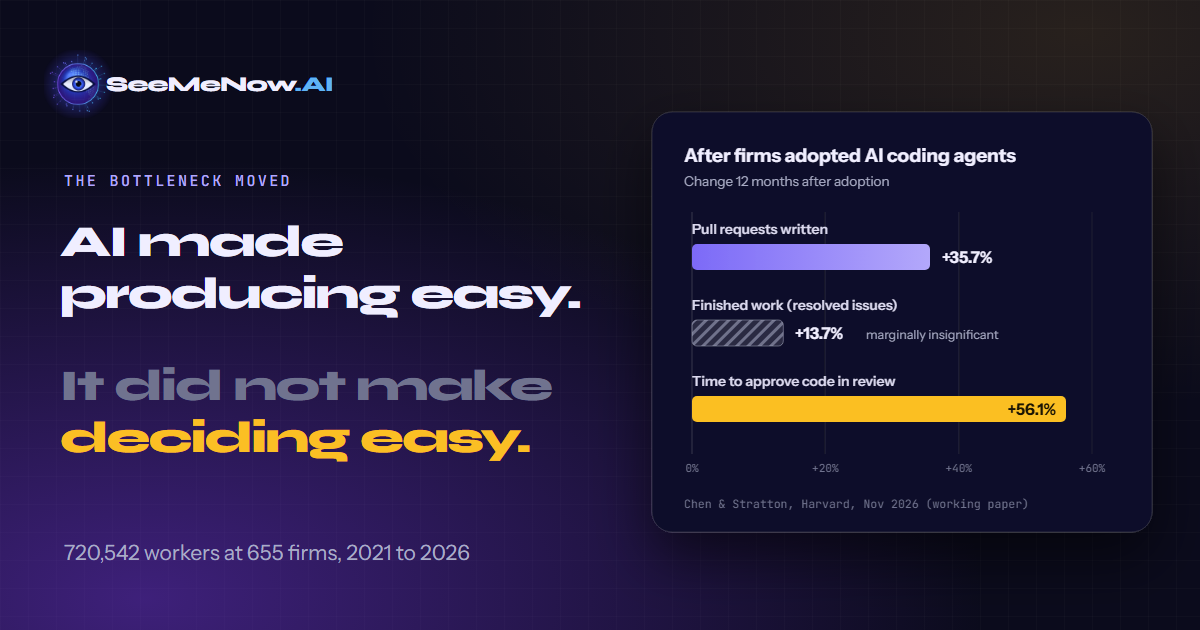
The tools worked, in the narrow sense. Twelve months after firms adopted AI coding agents, lines of code rose 44.0%, commits rose 36.0% and pull requests, the bundles of code submitted for review, rose 35.7%. Those gains came on top of what earlier AI coding assistants had already added.
Finished work did not keep pace. Resolved Jira issues, which count work that has gone live, rose 13.7%, and resolved epics, which count larger projects, rose 18.0%. The authors call both “marginally insignificant”: smaller than the jump in code, and too uncertain to be sure of. The authors also found no detectable effect on employment.
The extra output went to review. After agent adoption, the time from submitting code for review to getting it approved rose 56.1%. Code waited 59.9% longer before anyone looked at it and spent 58.5% longer in active review, and each change drew 38.6% more comments. AI review tools did not clear the queue: 79.1% of the firms had adopted them, but people still wrote the large majority of reviews.
Two cautions. This is a working paper, not yet peer-reviewed, and the authors note the effects may differ outside the mostly medium-to-large software firms they studied. But they also argue the split between doing the work and judging it is “nearly ubiquitous across knowledge work settings.” Marketing is one of those settings.
The marketing version of the review backlog
In software, unreviewed code sits in a queue where everyone can see it. Marketing has no such queue. A published page goes live, and in most teams nobody comes back to check whether it held a ranking, earned a mention in an AI answer, or brought in a lead.
So the backlog is invisible. It is the growing pile of pages, posts and rewrites that went out and were never judged. The team ships more each month, rankings look much the same, and when a client or a manager asks what moved the needle, nobody can point to a page and say “that one.”
The step before writing gets skipped too. When producing a page costs almost nothing, choosing which page to produce feels like overhead. That leaves three decisions that AI writing tools do not make for you:
- Which page to work on. Out of hundreds of pages and thousands of searches, the few where a change is most likely to pay off.
- What it should say. Including what your business knows first-hand that a competitor, or a model trained on the same web, cannot write.
- Whether it worked. A clear verdict, measured against the rest of the site, so a good season is not mistaken for a good change.
Define what “worked” means before you write
Software teams have an old habit for this: write the test before the code. The test says what “done” looks like, and the work is checked against it. With AI writing more of the code, defining that check has become a bigger share of the engineer’s job.
The marketing version is to decide the outcome that counts before anyone writes a word. Not “publish a page about retaining walls,” but something you can check later:
- Rankings held or improved on the target page for its main search.
- A citation in Google AI Overviews for a named search.
- A buyer question that ChatGPT or Gemini now answers with your business in it.
- More leads from that page, as Google Analytics 4 records them.
Take Cedar & Stone Landscaping, a fictional business we use for examples. Before rewriting its retaining-wall page, the team writes down one goal: be named when someone asks an AI assistant who builds retaining walls in their area. The brief, the first-hand answers from the crew, and the follow-up check all point at that goal. Thirty days later the answer is yes, no, or not yet, not “the page looks better.”
Before the briefExample · Cedar & Stone Landscaping
- Page
- /retaining-walls/
- Worked means
- Named when an AI assistant is asked who builds retaining walls in the area
- Also watch
- Ranking for “retaining wall contractors” holds; quote requests from the page in GA4
- Check at
- 30, 60 and 90 days
- Verdict
- YesNoNot yet
What changes when the bottleneck is deciding
If deciding is the bottleneck, writing faster does not help. Three things do.
Fewer, better-chosen pages. A short list of changes picked from your own Search Console and analytics data beats a content calendar filled because the tool made it easy. Every page you do not write is one less thing to check.
A verdict on every change. Each finished piece of work gets a “worked” or “did not work,” on a fixed schedule, against the goal you set before writing. Over a few months, that record tells you which kinds of change pay off for this site, and the next round of decisions gets better.
A system doing the reading, people doing the judging. The software study found that AI review tools did not remove the bottleneck, because people still did most of the reviewing. In marketing, the slow part is not approving a page but reading the data that says which page matters and whether it paid off. That reading can be done by a system, and the approval stays with your team.
Where SeeMeNow.AI fits
We built SeeMeNow.AI for the deciding step, not the writing step. It is a decision engine: it reads your Google Analytics 4 and Search Console data, checks how ChatGPT, Gemini and Google AI Overviews answer your buyers’ questions, and every Monday hands you three or four ranked moves with the numbers and the reason behind each one.
It drafts the work for each move, using your own first-hand answers collected in Google Docs, and nothing changes on your site until someone approves it. Every finished change is then measured at 30, 60 and 90 days against your whole site, so you know which ones paid off. You can try it on one brand or one client for 14 days, free, with no card required.
Sources
Fiona Chen and James Stratton, “Artificial Intelligence in the Firm: Bottlenecks in Software Production,” Harvard University job market paper, current version 8 November 2026, first version 7 January 2026 (PDF). Sample, data range and method: abstract and introduction. Code output, resolved issues and epics, employment, review times and comments, AI review tool adoption: introduction, pages 3 to 5. “Marginally insignificant”: results section. Scope caveat: conclusion. “Nearly ubiquitous across knowledge work settings”: introduction, page 3.