The digital marketing landscape is transforming, driven by AI. For marketing teams, optimizing for AI visibility is a strategic imperative, especially as teams plan the months ahead. Customer discovery has shifted beyond traditional search to AI-powered assistants and generative AI overviews.
Ignoring this shift risks rendering marketing efforts invisible where future customers engage. AI visibility in 2026 means ensuring your products, services, and expertise are prominently featured and accurately cited within responses from leading AI models like ChatGPT, Gemini, and Google AI Overviews. These platforms are becoming primary information gateways, directly answering user queries and often bypassing traditional organic search results. This alters the customer journey, demanding a proactive approach to how brands present themselves to these new digital gatekeepers.
Planning the months ahead is the right moment to integrate AI visibility into your marketing strategy. This period allows for an audit of current AI presence, development of tailored content, and resource allocation. Neglecting AI’s impact risks decreased brand recognition, missed lead generation, and competitors dominating new recommendation channels. Brands that fail to adapt risk becoming footnotes in an AI-driven world.
Measuring Your Brand’s AI Footprint
Effectively measuring a brand’s presence within AI search environments requires a distinct set of metrics and a systematic approach. Strong AI visibility is indicated by consistent brand mentions and direct citations of your website as a source within AI-generated answers, particularly for queries relevant to your industry and offerings. Conversely, weak visibility is characterized by an absence of mentions, incorrect information, or the frequent recommendation of competitors when your brand should be a primary consideration.
Tracking brand mentions and citations within AI answers involves regularly querying AI assistants with questions your target audience would ask. This process identifies not only if your brand is named but also where in the answer it appears (early, middle, or late) and which specific sources are cited. Understanding the context and prominence of these mentions provides critical insights into how AI models perceive and present your brand’s authority and relevance.
Competitor mentions play a pivotal role in AI visibility analysis, often highlighting gaps in your own strategy. If AI assistants frequently recommend competitors for queries where your brand should be a strong contender, it signals an urgent need to optimize your content and presence for AI discovery. Analyzing which competitors are named and for what types of questions helps to pinpoint specific areas for improvement, allowing you to refine your content to directly address these competitive recommendations.
Brands should re-check their AI visibility frequently, ideally every two weeks, because AI answers are dynamic and can change rapidly due to model updates, new data ingestion, and evolving web content. Regular scans help detect these shifts promptly, allowing marketing teams to respond proactively to maintain or improve their standing. At SeeMeNow.AI, we scan every two weeks on a business day, mixing questions that follow your market with fixed control questions to ensure meaningful change detection and fair comparison.
Strategies to Boost AI Visibility for Your Brand
To improve a brand’s visibility in AI search results, marketing teams must adopt content strategies tailored to how AI assistants process information. This involves creating highly structured, authoritative, and easily digestible content that directly answers common user questions within your niche. Focusing on clear, concise explanations, factual accuracy, and comprehensive coverage increases the likelihood of your content being identified as a valuable source by AI models.
Ensuring your “first-hand knowledge” is discoverable by AI models means making your unique insights, proprietary data, and expert opinions readily accessible and clearly attributed on your website. This includes publishing detailed case studies, whitepapers, research findings, and in-depth guides that showcase your specialized expertise. AI models prioritize authoritative sources, so establishing your brand as a definitive voice through high-quality, original content is paramount.
Common pitfalls in content creation that hinder AI visibility include vague language, lack of clear topic focus, and content not well-structured for machine readability. Overly promotional or keyword-stuffed content can also be detrimental, as AI models provide unbiased, informative answers. Content lacking depth or failing to address user intent comprehensively will likely be overlooked.
Identifying and addressing questions where AI names competitors but not your business requires systematic competitive analysis within AI environments. This involves regularly querying AI assistants with unbranded questions a customer would ask, then analyzing responses to see which brands are recommended. Once gaps are identified, create targeted content to directly answer those questions, ensuring your brand’s unique value proposition is clearly articulated and optimized for AI discovery. Our platform collects first-hand answers for content, helping to close these identified gaps.
Integrating AI Visibility into Your Marketing Workflow
Incorporating AI visibility into your marketing workflow requires practical steps. Designate a team member to oversee AI visibility. Embed regular AI visibility checks into your marketing plans, treating it with the same importance as traditional SEO audits. This consistent monitoring allows for timely identification of opportunities and threats.
Prioritize actions based on AI visibility insights. If AI assistants frequently recommend a competitor for a high-value keyword, addressing that gap becomes a top priority. If your brand is already mentioned, enhance its prominence or accuracy. Prioritization should align with business objectives like lead generation or brand awareness.
Tools and processes connecting AI visibility data to actionable tasks are essential. This includes platforms that automate AI scanning, analyze results, and generate specific recommendations. Integrating these insights into project management tools ensures AI visibility tasks are assigned and completed. Our Decision Engine prioritizes actions, providing clear guidance on what to do, why, and how to measure success.
Communicating AI visibility performance to leadership requires translating data into business insights. Focus on metrics demonstrating tangible impact, such as increased brand mentions or improved citation quality. Present findings alongside implications for market share and revenue potential, emphasizing the strategic advantage gained through proactive AI visibility management. For in-house teams, demonstrating this value is crucial for securing resources.
Navigating the Future of AI in Marketing
The future of AI in marketing demands agility. Anticipated developments in AI models like ChatGPT, Gemini, and Google AI Overviews will likely include enhanced reasoning, sophisticated content synthesis, and deeper real-time data integration. These advancements will refine how brands are discovered, emphasizing verifiable, authoritative information. Marketing teams must monitor these shifts to adapt proactively.
Evolving user behavior with AI assistants will shape future marketing strategies. As users become accustomed to direct, conversational answers, their reliance on traditional search results may diminish. This necessitates optimizing for direct answers and recommendations, rather than solely for website clicks. Brands will need to prioritize clarity, conciseness, and immediate value within an AI interface.
Ethical considerations and transparency regarding AI-generated content are increasingly important. Marketing teams must be aware of potential AI “hallucinations” or misinformation, ensuring their brand’s content is robust enough to counteract inaccuracies. Transparency about AI’s role in content creation, along with a commitment to factual accuracy, will be crucial for maintaining brand trust. Adhering to ethical guidelines is a cornerstone of long-term brand reputation.
Continuous learning and adaptation are key to long-term AI visibility success. The AI landscape is too dynamic for static strategies. Marketing teams should invest in ongoing education, participate in industry discussions, and experiment with new approaches. This commitment to perpetual learning fosters an adaptive mindset, positioning brands to thrive amidst technological transformation.
Unlock Your Brand’s Full AI Visibility Potential
Proactive AI visibility management is a fundamental requirement for marketing teams seeking strategic advantage. Understanding how AI assistants perceive and present your brand is critical for the planning ahead and beyond. By systematically measuring your AI footprint, implementing targeted content strategies, and integrating these insights into your workflow, you can secure a dominant position in the evolving digital ecosystem.
The complexities of AI visibility analysis demand a dedicated approach to ensure your brand is accurately represented and frequently recommended. Leveraging specialized tools for AI visibility analysis provides the depth and accuracy needed to make informed strategic decisions.
Frequently Asked Questions
What is the difference between traditional SEO and AI visibility optimization?
Traditional SEO focuses on ranking high in search engine results pages (SERPs) to drive organic traffic. AI visibility optimization centers on ensuring a brand is mentioned, cited, and recommended within direct answers from generative AI assistants and AI Overviews. Both aim for digital presence, but AI visibility emphasizes direct answers and recommendations over website clicks.
How does AI’s ‘hallucination’ risk impact brand reputation and how can it be mitigated?
AI “hallucinations” can generate false information, damaging brand reputation if associated with your brand. Mitigating this involves ensuring your online content is exceptionally clear, factual, and authoritative, making it less susceptible to misinterpretation by AI models. Regularly monitoring AI mentions of your brand also allows for swift correction of inaccuracies.
What are the specific challenges for B2B vs. B2C brands in achieving AI visibility?
B2B brands often explain complex solutions to a niche audience, requiring detailed content AI can summarize. B2C brands struggle with competitor volume and need engaging, factual content for broad consumer queries. Both require precision, but B2B leans into depth, while B2C needs broader appeal without sacrificing accuracy.
How do AI Overviews differ from traditional search results in terms of brand exposure?
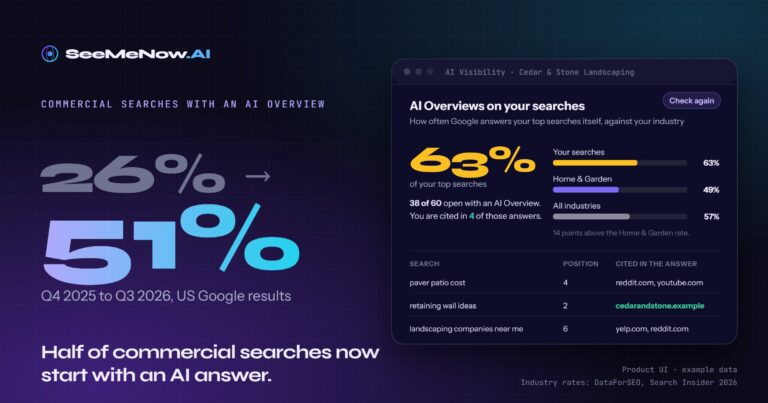
AI Overviews provide a summarized answer directly at the top of Google’s search results, often reducing the need for users to click through. Brand exposure shifts from a prominent listing to being explicitly mentioned or cited within the overview. Brands need to optimize for inclusion in these summaries, as they significantly impact initial user perception.
What are the best practices for structuring website content to be easily digestible by AI models?
Best practices include clear headings, concise paragraphs, and structured data markup (schema.org). Providing definitive answers to common questions, using bullet points, and ensuring factual accuracy also helps AI models understand and synthesize your content effectively. This structured approach facilitates accurate extraction of key information.
How can marketing teams measure the ROI of their AI visibility efforts?
Measuring ROI involves tracking direct brand mentions and citations within AI answers, monitoring changes in brand sentiment, and correlating these with traditional metrics like website traffic, lead generation, and conversions. Attributing improved brand awareness or specific lead sources to AI visibility efforts helps demonstrate tangible value.
Strategic AI Visibility for Marketing Teams
AI visibility is a strategic imperative redefining how brands connect with their audience. Proactively managing your brand’s presence within AI environments ensures relevance and competitive advantage in an increasingly AI-driven world. This forward-thinking approach is essential for sustained growth and market leadership.
Navigating the complexities of AI visibility requires specialized expertise and advanced analytical capabilities. SeeMeNow.AI provides the tools and insights necessary to understand your brand’s AI footprint, identify critical gaps, and implement effective strategies. Our decision engine helps marketing teams translate complex AI data into actionable plans that deliver measurable results, ensuring your brand is seen and cited where it matters most..